
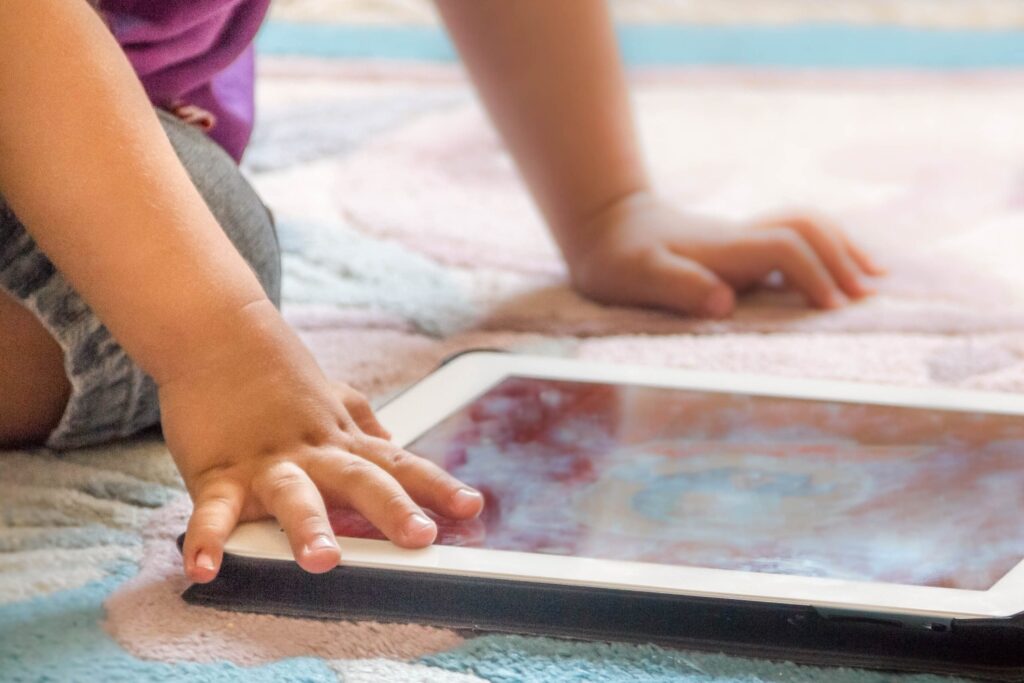
It’s raining for the third day running, half the pre-school room has a cold, and someone suggests putting a film on after lunch to calm everyone down. It’s a very ordinary idea. Under the EYFS framework that came into force in September, it’s now one worth thinking twice about.
A guidance document you now have to follow
From 1 September 2026, the EYFS requires providers to have regard to the Department for Education’s screen use guidance for early years settings. “Have regard to” means you are expected to follow it unless you have a good, recorded reason not to. It builds on the advice for parents that the government published in March.
The guidance is short and clear. The main points are:
- Under twos: avoid screen time altogether, except in exceptional circumstances such as a video call with a parent or carer.
- Two to five year olds: no more than an hour a day, and less if possible. Children may already be reaching that at home.
- Timing: screens only for short periods, and not at mealtimes or within an hour of a sleep.
- Purpose: screens are not to be used to manage routines, to calm children down or to keep them occupied.
- Content: checked in advance, slow-paced and predictable, free of adverts, and without autoplay or scrolling.
- Adults involved: no passive viewing. An adult watches with the children, talks about what they see and asks open questions.
So the rainy afternoon film fails on several counts. It’s close to naptime, its job is to keep children quiet, and nobody is talking with them about it.
What screens can still be used for
The guidance doesn’t ban screens in settings. A short clip of a real hedgehog, watched together after finding one in the garden, fits it well. So does looking up what a digger does after watching one outside the fence, or a video call with a parent who works away. The common thread is that the screen is part of a conversation with an adult, used on purpose, for something the children are already curious about.
The guidance also warns that an app described as “educational” or “designed for children” is not automatically suitable. Many are fast, noisy and built to keep children tapping. Someone who knows early child development should check each one before it’s used.
Bringing parents with you
Settings are expected to share their approach with families, including whether, when and how screens are used, and the recommended limits for home. The guidance asks for that to be done in a non-judgemental way. Many parents lean on a tablet at the end of a long day, and a lecture at pick-up won’t change that. A practical conversation about alternatives and routines has a much better chance. Our Building Partnerships with Parents course covers how to have that kind of conversation without anyone feeling criticised.
Online safety starts with the youngest
The guidance sits alongside the safeguarding side of technology: what children might see, what information is shared about them, and how settings use devices themselves. We looked at this in May in online safety for children who can’t read yet. Our course Online Safety in Early Years gives the whole team a shared understanding of the risks and of the setting’s role in helping families manage them.
Staff phones are a separate matter, covered by your device policy rather than the screen use guidance. They are worth reviewing at the same time. Children notice where the adults’ attention goes, and a practitioner checking a phone in the room works against everything the guidance is trying to achieve.
Help your team handle screens and online risk with confidence.
Online Safety in Early Years covers the digital risks facing young children and how settings can support families, with an NFAQ-accredited certificate on completion.
A good first step is to write a one-page screen use policy, share it with the team and send it home with the next newsletter. Many settings will find it simply records what they already do. If a rainy afternoon film has become routine, that is the thing to change.