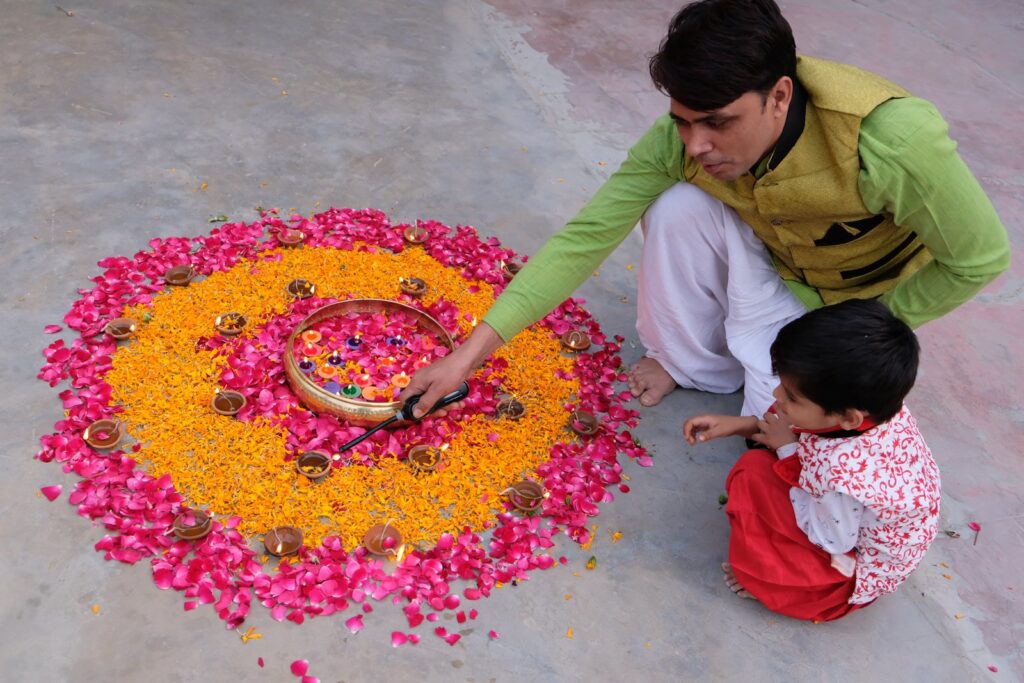
Diwali falls on Sunday 8 November this year, with celebrations running across the five days around it. In many nurseries that means a week of rangoli patterns, paper diyas and a story about Rama and Sita. Those activities can be lovely. They can also be the only time a child’s culture appears in the room all year, which isn’t quite the point.
Celebrating is not the same as including
Early years educators sometimes call it the “tourist approach”: a culture appears for one week, usually as food, costumes and crafts, and then disappears again. Children learn that some festivals belong to “us” and others are something “we” visit. A child who celebrates Diwali at home may enjoy the week. They may also notice that their family’s life only shows up in nursery once a year, and only as something unusual.
The EYFS lists equality of opportunity and anti-discriminatory practice, so that every child is included and supported, among the principles that underpin it. The Equality Act 2010 sets the legal framework, and promoting fundamental British values includes mutual respect and tolerance of different faiths and beliefs. In practice, inclusion happens across the whole year, through everyday resources, routines and conversations.
Start with your own families
The best guide to which festivals matter in your setting is the families in it. Ask at registration, and again from time to time, which celebrations are important at home and how they’re marked. A Hindu family, a Sikh family and a Jain family may all celebrate Diwali in different ways. Families may also celebrate several festivals, or none.
Invite families to share if they’d like to. A parent showing children how they make rangoli at home, or a grandparent bringing in sweets they make every year, gives children something much richer than a worksheet. Make it an invitation, never an expectation. Not every family wants to be the one that explains their culture to everyone else.
Make it part of the everyday
- Books: stories where children from many backgrounds appear in ordinary situations all year round.
- Role play: cooking pots, fabrics and dolls in the home corner that reflect the families you serve.
- Language: greetings and songs in home languages, learned from families.
- Food: dishes that appear on the menu throughout the year, with allergens checked as usual.
When Diwali does come round, children who already see those things every day will understand it as part of a familiar world, not a novelty.
Doing festivals well
Keep the focus on what children can relate to: light, family, sharing food, giving and new clothes. Check facts with families or reliable sources rather than relying on a craft website. Be careful with diya activities: battery tealights are fine, and real flames are not. And treat all festivals in the same way. If Christmas gets a month of build-up and Diwali gets an afternoon, children will notice the difference.
Our Equality and Diversity (Level 2) course covers the Equality Act, the protected characteristics and inclusive practice with children and families. British Values in the Early Years shows how mutual respect and tolerance look in a room full of two and three year olds.
Make inclusion part of every day of the year.
Equality and Diversity (Level 2) covers the Equality Act 2010 and inclusive practice in early years settings, with an NFAQ-accredited certificate on completion.
Enjoy the rangoli and the lights this week. Then look around the room in January and ask whether the same children can still see their families reflected in it.