
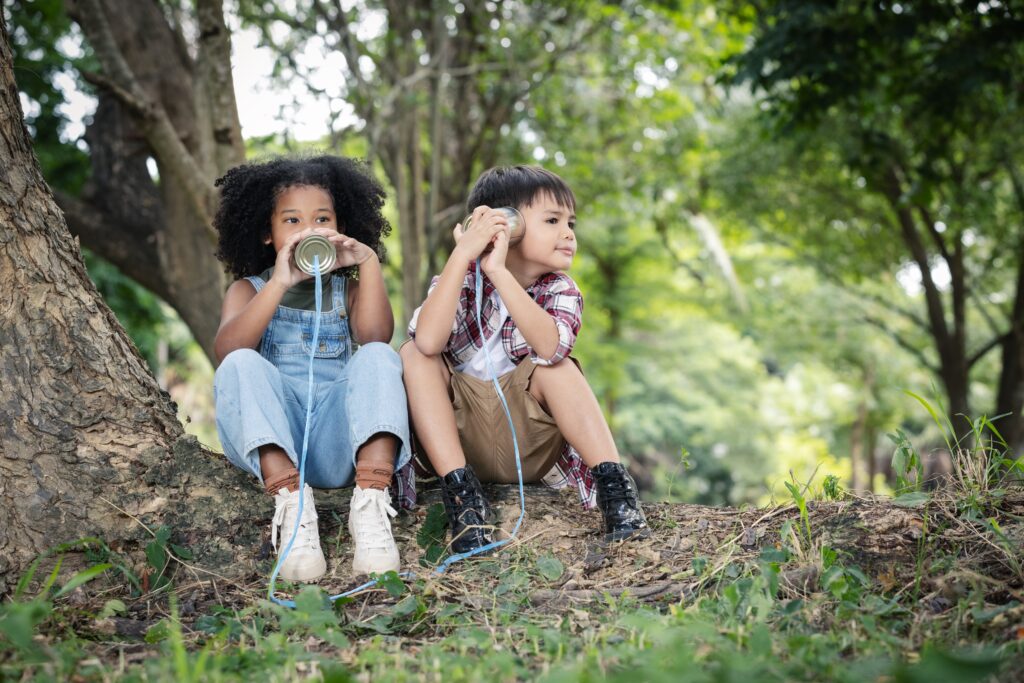
Mid-July, half past ten, and the garden is doing what nursery gardens do in summer: bikes circling, a queue for the slide, somebody watering the same patch of gravel with tremendous concentration. It looks lovely. The question worth asking is what everyone is actually learning out there.
We hear a version of this from managers a lot. The team takes the children outside every day, the children adore it, and yet outdoor time can drift into a kind of pleasant supervision, a breather between the “real” learning that happens at tables indoors. That split doesn’t hold up, and the EYFS doesn’t support it either.
What the EYFS actually expects
Development Matters recommends outdoor play as a teaching tool that supports all seven areas of learning. Not just physical development. All seven. Communication happens differently outside, where there’s room to shout, negotiate den ownership and narrate a worm’s progress across a paving slab. Maths turns up in guttering angles and bucket capacities. Early writing gets a look in with decorating brushes and a pot of water on a sunny fence.
Outdoor play should also be a regular feature of every child’s day, not an occasional treat for when the weather behaves. In a British summer that principle gets tested in both directions, sunshine one week and sideways rain the next, which is why good outdoor provision comes from planning rather than luck.
Three kinds of outdoor play worth planning for
It helps to think about the outdoors in categories rather than as one green blur. Physical play is the obvious one: climbing, balancing, pedalling, lugging heavy things about with great seriousness. Constructive play uses crates, planks, tyres and fabric so children can build dens and obstacle courses of their own devising. And investigating the world covers the minibeast hunts, puddle science and cloud watching that make the outdoors impossible to replicate inside.
A garden that only offers the first category is underused. The happy discovery, once a team starts looking at provision this way, is that the second and third categories are usually the cheapest to resource.
Water deserves singling out in July. A trickle from the hose down a length of guttering gives you capacity, flow, cause and effect and a great deal of negotiation about whose boat goes first, all before snack time. Add shade, sun hats and a drinks station nearby, and a hot morning becomes an asset rather than a hazard to be managed.
The outdoors also supports every one of the Characteristics of Effective Learning. A child who spends forty minutes engineering a water channel across the patio is playing and exploring, learning actively and thinking critically all at once, and an observant practitioner can capture the lot. Our Outdoor Play in Early Years course maps all of this out, with practical ideas your team can use whatever the size or shape of your outdoor space.
The barriers are real, but they’re solvable
Every setting has its reasons for not using the outdoors fully. A tiny yard. Staffing that makes free flow tricky. A team member who quietly hates the cold. Parents who worry about muddy trousers. None of these is imaginary, and none of them is a dead end either.
Small spaces reward vertical thinking: planters, fixed climbing panels, resources that hang. Free-flow struggles often ease when the outdoor area is treated as a planned learning environment with an adult stationed there on purpose rather than by rota accident. And the muddy trousers conversation goes far better when parents can see what the mud was for, which is where sharp observations linked to areas of learning earn their keep twice over.
Summer is the easy season for all of this. The harder question is whether the same children will still be learning outside in November. Teams that plan for that now, while the sun makes everything feel possible, are the ones whose gardens stay purposeful all year round.
Turn your garden into a proper teaching space
Outdoor Play in Early Years covers what the EYFS expects, the types of outdoor play and practical fixes for common barriers, with a completion certificate for your CPD and compliance records.
Garden time is fine. Garden time with intent is early education at its best.